After reading the General Feedback of Task 1 on ILearn I decide to write something from my heart.
How to write this blog has been a pressure for me as I have not tried out any Virtual Reality (VR) apps yet. I stuck at the beginning when I tried to log in Cospaces. I forget the code for joining the class. I feel like I really need extra help with hands-on activities. There are several reasons for this. First, I myself am not familiar with all apps covered in class so far. I have never played digital games in my life. So, there is no transferable knowledge in terms of gaming and coding. Other than that, I think language barrier is also a problem for me. I am still thinking what this word means when my classmates are busy with their designs. I can imagine if I am going to integrate VR into my lessons some students may experience difficulties as I do. How to differentiate the leaning task to cater for different learners is something I should pay attention to when I do my lesson plans of Task 3.
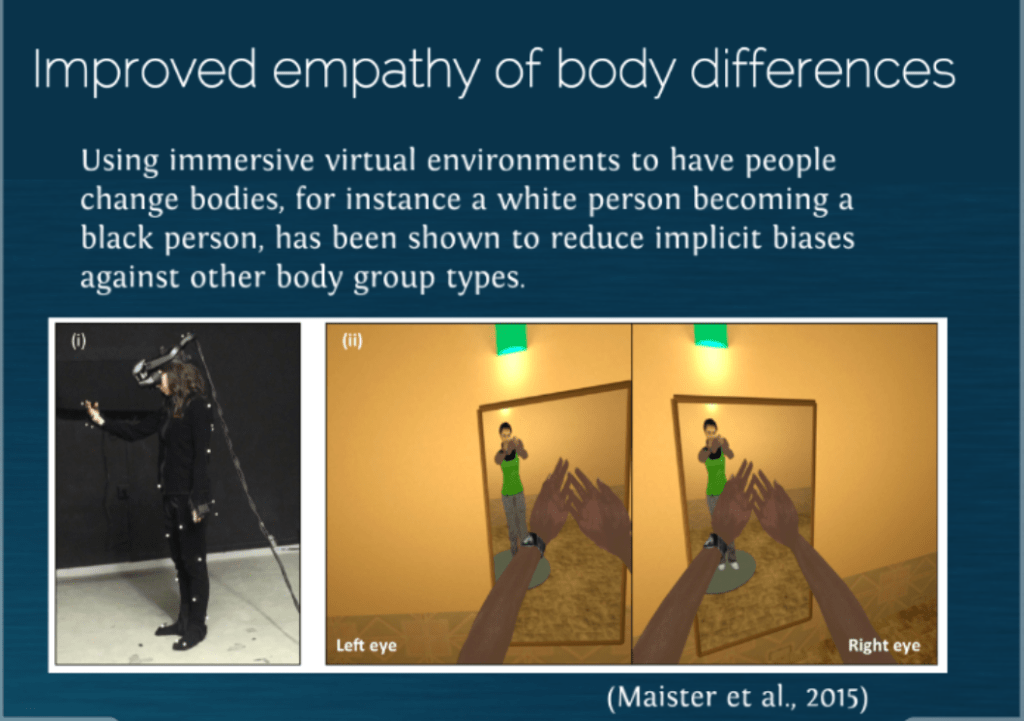
It was hard to imagine the motion of molecule or atom and doubted their existence when I learnt physics or chemistry over thirty years ago. But with the technology of VR you can “be” a molecule or atom to interact with micro worlds! Or you can change the size of yourself as big as you want to manipulate the world around you. These two perspectives are what Dede calls egocentric and exocentric perspectives (Dede, 2009). Both of them have different strengths for learning. The main benefit of egocentric perspectives is that they enable participants’ actional immersion and motivation through embodied, concrete learning, while exocentric perspectives foster more abstract, symbolic insights gained from distancing oneself from the context (Dede, 2009). For example, one study found that VR can even serve as “empathy machine” to challenge people’s stereotypes and bias by swapping perspectives with a person who is from a different ethnic, cultural or religious group (Southgate, 2018).
High motivation and engagement in learning is one of advantages of VR (Southgate, 2018). But to some extent does high engagement mean a tendency to become addicted, which is reflected in the film Inception?

(I have to explain why I watched this film. Last year my husband suggested me to watch Inception maybe he thought I was too outdated in terms of technology or human mind? But that was not my type of film because of violence and intensity. Yesterday I thought it was the time for me to watch it when I found it is hard to continue writing this blog.)

Also how to distinguish between reality and virtuality when exposed to AR for long term, especially for young children (Southgate, 2018)? The philosopher David Hume believes that the world is what one perceives. As a result the experiences gained from AR may be true reality for some, like character Mal in Inception believes? This is similar to Chinese tale of the Butterfly Dream.
Facebook’s CEO predicts one billion people will be living in immersive virtual reality in the future (ABC news, 2017, October 12, as cited in Southgate, 2018). I wonder this is virtuality or reality?
References
Bower, M. (2020). VR in education [ilecture]. Retrieved from https://prezi.com/l3qaqw9zz3uq/educ3620-2020-vr-in-education/?token=4b6eb0a71d9f57ef0ca3df225bc83039392f24694bc5e053cdf897da9037fdad
Dede, C. (2009). Immersive interfaces for engagement and learning. science, 323(5910), 66-69.
Southgate, A. E. (2018). Immersive virtual reality, children and school education: A literature review for teachers., (6).
Thomas, E., & Nolan, C. (Producer), & Nolan, C. (Writer/Director). (2000). Inception. Legendary Pictures.


Hello Change,
I enjoyed reading your post very much, I found it extremely unique.
I’d like to begin my comment by saying how much your first paragraph resonated (stuck), with me! Whilst studying to become a teacher at university I also completed a specialisation in English as an Additional Language/Dialect (EAL/D) so I am always considering how my studies relate to EAL/D students in my classroom. I have been following your blog and I deeply respect your reasons for seeking to develop your understanding of digital technologies. I also appreciated your comment that the struggles you have had with VR will likely be struggles that your students will have. I imagine the cognitive load one experiences when trying to understand the highly academic language used in digital technologies is very heightened for second language learners.
However, I also see the benefits of technology such as VR for EAL/D students. One example that springs to mind is when an EAL/D student is struggling to verbally explain their understanding of a certain topic, especially one that involves spatial aspects (geometry, for instance). Once students are able to functionally operate platforms like CoSpaces they would be able to express their understandings visually, better than ever before. Do you agree? Do you see benefits for VR in a classroom like yours?
I would be very interested to hear your thoughts.
Regards,
Miss Wilkes.
LikeLike
Hi, Miss Wilkes,
Really appreciate your understanding! Sometimes it is really hard to find someone who can understand my struggles.
Now I can see why some of my students often don’t do their work properly:) I think language barrier is one of reasons. Now I am trying to use simple Chinese or a mixture of Chinese and English for heritage learners. Being a student really helps me to view things from students’ perspectives.
Yes! absolutely! the benefits of digital technology in education is profound! The way we are doing our unit now is a good example of it. Actually I had negative disposition towards digital technology before studying this unit. I did not understand that why my daughter liked spending so much time on her IPad and that when it came to study she was not willing to do it. Why can’t we make something fun to play and at the same time make kids to learn? I enrolled in this unit with this question. Now I know the power of digital technology. I am trying them out at my Saturday Chinese class after learning something new at our tutorials, for instance, Zapworks, e-portfolio. It really works.
Very happy to have you as my peer, so inspirational!
Change
LikeLike
Hi Change,
Perhaps I have an empathetic nature! But mostly I think I am able to understand struggles such as yours because I have travelled to many countries where English is not commonly spoken, giving me direct experience in trying to communicate in a foreign language. Those experiences alone have made me realise how difficult it must be for students in my classroom, and for university students like yourself, trying to learn highly complex concepts in a language where you are constantly having to decode! I’d like to think I’ll be able to use some of the technologies we have learnt about in this unit to help my students better express themselves.
I feel the same! I currently run a private tutoring business and I feel like I can understand their perspective much better simply because I am still a student myself. I hope I can hold onto being a lifetime learner as a teacher so that I do not lose that as I think it makes for far better teaching.
“Why can’t we make something fun to play and at the same time make kids to learn?”. Brilliant. I think that summarised this entire unit! And how wonderful that you are already about to try it out, finding it is working! Very exciting!
I feel that same way about you Change: putting yourself into a situation that you profess to know nothing about, perhaps even judge, but remain open to learning about – I feel this is what all teachers should aspire to do, no matter the stage in their career.
Respectfully,
Miss Wilkes
LikeLike
Hi, Miss Wilkes,
I have a lot to say in my head, but I don’t know how to say it in English. Actually I have read your comment in the morning and paused there because your words are like a stone thrown in a river and rippled.
SAME: life learner and remain open to new things!
ALL THE BEST, Shellie!
Chang’e
LikeLike
Hi Change,
I, too, agree that your blogs are very unique and interesting to read! (Which is why I’ve commented on 3 of your blog posts consecutively…) I know this is an academic task, but I thoroughly enjoy the personal details you add to your blog, like why you’ve used Inception as an example or how pressured you felt to write this blog post! I definitely can relate to that – especially trying to learn about virtual reality when your only reality is on zoom!
I found this virtual reality app that I thought might be relevant to your Chinese teaching – the app is called Learn Languages VR, and basically it puts you into real-life scenarios where you need to converse in foreign languages to virtual people. I think it would be great to integrate into your Chinese lessons, as it really gives you a sense that you are using a language in context! Let me know if you manage to take a look at it – I’ve also reviewed this in my blog if it interests you. 🙂
祝你這個學期考試成功!
Hayley
LikeLike
Hi, Hayley,
I couldn’t stop laughing when I read “especially trying to learn about virtual reality when your only reality is on zoom!” Like your humor!
I found you always have something to offer to me:) and It is a surprise that you write Chinese, yes, I know you grew up in Hongkong.
真的非常感谢你!
也祝你学习就业一切顺利!
长娥
LikeLiked by 1 person