In Asian culture students must take learning seriously. Play is not viewed as “real” learning, let alone computer games. But nowadays spending a few hours on computer games each day is normal for young people. A 2019 report estimated that global games market would generate $152.1 billion in 2019. How to integrate computer games into teaching and learning has attracted a lot of attention.
The story of dice games invented in the kingdom of Lidia is a great example of how engaged and motivated the players were (McGonigal, 2010). This is also evident when computer games designed in teaching and learning activities (Mayer, 2014, as cited in Mayer, 2019). Other than this there are other educational benefits of video games, such as cognitive benefit, games have been shown to improve attention, focus and reaction time (Granic et al., 2014, as cited in Bower, 2020).
However, Mayer (2019) suggests that visionaries’ strong claims for educational value of computer games need to be tested as there is relatively little research evidence on the effectiveness of simulations and games for learning. For example, Granic (2014) believes that gamers are able to translate the prosocial skills that they learn from gameplaying to peer and family relations outside the gaming environment (as cited in Bower, 2020). But personally, I found that when young people in my neighbourhood are addicted to video games they are often withdrawn from family members and society. Ten years ago Jane McGonigal said “Reality is broken, we need to make it work more like a game” (McGonigal, 2010). Ten years have passed now I have experienced profound transformation made by digital technologies. Sometimes I am really curious about what kind of world the digital technology will lead us to.
To me study this unit is to walk into another world which I am always scared of. Regardless as an educator or as a parent I need to keep up to date with technologies. Yesterday I tried out Scratch.
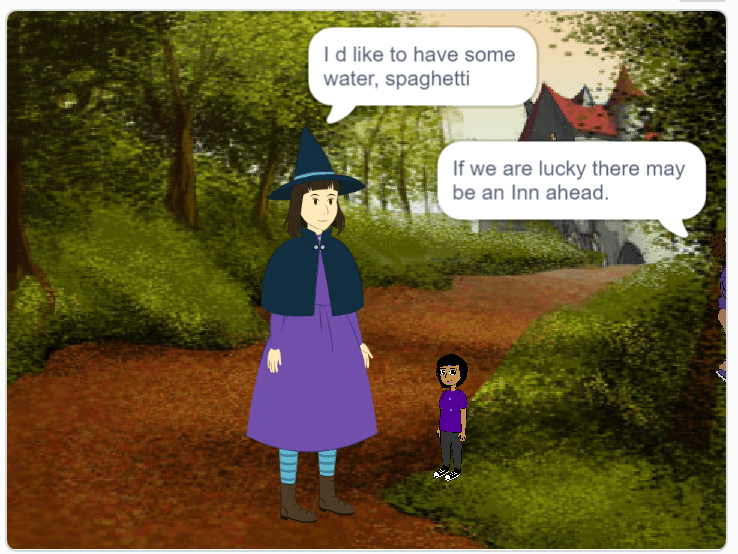
My own experience with Scratch is that it allows creativity and computational thinking by creating stories, games or animation. The project I did is to create a story using emotion words and eating/drinking words. If this is for students learning Chinese language they can bring their personalized creations to share and reflect on the differences of food cultures around the world. The negative experience with Scratch is that the coding language is somewhat confusing. For example, you can start by clicking green flag, later I discovered that clicking the sprite is another way to get started. When the whole story is finished I find it is hard to understand because the sequence of the events is messy. Then you have to write instructions for readers to watch. Book Creator is much easier to use than Scratch in this regard. Being familiar with features of Scratch is time-consuming. Time management will be a challenge if implementing Scratch activity in a normal 45 minutes lesson.
References
Bower, M. (2020). Games and Learning [ilecture].
Mayer, R. E. (2019). Computer games in education. Annual review of psychology, 70, 531-549.
TED2010. (2010, February). Game can make a better world [Video file]. Retrieved from https://www.ted.com/talks/jane_mcgonigal_gaming_can_make_a_better_world?language=en


Hi Change
Very interesting blog which i enjoyed reading. I really like how you discussed gaming from many different perspectives, including you own anecdotal experiences.This was really intriguing and definitely gave well-a grounded, thorough background knowledge on digital games and their effects on students’ cognitive and social abilities. I also like your take on different perspectives and arguments for integrating games into education by highlighting the positives and negatives, which provided a comprehensive, unbiased stand. Great idea to discuss Scratch as a source for digital game integration, as it provides students opportunities to be knowledge creators and not only receivers, through opportunities to create games. Also a good idea to identify negatives, such as time constraints and complexity of learning to use the program. However, I would have liked to see more information of how it can be integrated into the classroom and the overarching pedagogies of games, as it would have been relevant to teachers interested in ways to incorporate digital games into their lessons.
LikeLike
Hi Change,
I definitely resonate with your sentiment about Asian cultures not considering “play” as learning – I grew up in Hong Kong and that’s definitely a large part of the culture there.
Thank you for sharing your first attempt with Scratch! I think you have done a great job, especially for a first go. I understand the coding blocks can be a bit confusing – the “when green flag clicked” or “when sprite clicked” blocks are called Triggers, and they often determine the sequence of codes. If you want to learn more, I would recommend checking out the “broadcasting” block on Scratch, so that you would not need to use so many triggers in your code and wouldn’t need to write down instructions for other Scratch users to view your animation. I only know this because I taught Scratch for 3 years! I think your first attempt was great though – just offering some advice 🙂
Feel free to check out my Scratch post! I created a game where students need to practice their time tables against a set timer.
Overall, I enjoyed reading your post, Change!
LikeLike
Oh, you taught Scratch for 3 years! I will definitely check out the BROADCASTING in this winter holiday.
Thank you very much for your encouragement! I am often shy with my works using digital technology.
LikeLiked by 1 person