Robotics education is becoming increasingly commonplace in schools. Here robotics education is referred to as to teach about robotics or other subject areas by adopting educational robotics technologies. One of the reasons for robotics education to gain growing attention from educators is that students will enter an era where robots will become widely used in their daily lives and workplace. Other than that, researchers suggest that robotics offer a means to empower learners and provide authentic learning (Jung & Won, 2018).
The educational potential of robotics mainly focuses on specific knowledge, skills and attitudes young children achieved. For example, programming knowledge, computational thinking skills, intrapersonal and interpersonal attitudes (Hwang & Wu, 2014), even though attitude domain is not the main purpose of majority studies (Jung & Won, 2018).
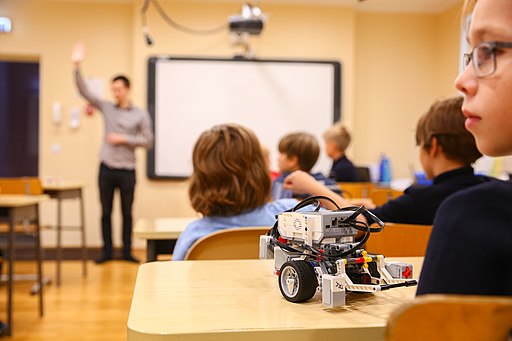
Most research highlight that the advantages of robotics education are to improve cognitive abilities and skills. This is a bias towards robotics education, it is also a reflection of technological determinism. Robotics education can combine academic learning and students’ social and emotional development through collaboration and corporation, it all depends on how teacher creates the learning environment and learning activities based on the learning outcomes. Therefore, as educators we really need to shift focus from technology to pedagogy based on learning outcomes (Alimisis, 2012).
Another issue associated with robotics education is assessment. How to assess students’ robotics learning is really complicated because it involves different subject areas, for example, mathematical, digital and social-cultural context (Savard & Freiman, 2016). As a result, whether successfully performing tasks or not cannot be only criteria. The criteria rely on what concept or skills are to be assessed and in which context they are to be used. For instance, in a Chinese language K-2 classroom, the learning outcome is students are able to understand and speak directional words in Chinese. The assessment task is to describe what a Bee-Bot is doing in Chinese. During task performance some students may not do it correctly due to various reasons, e.g. not familiar with robot. But when these students perform an ask-and-do task (teacher asks students to turn left/right, go straight in Chinese) and do well, and they can also ask their peers to do the same, then their intended learning outcomes are achieved.
References
Alimisis, D. (2012). Robotics in education & education in robotics: Shifting focus from technology to pedagogy. In Proceedings of the 3rd International Conference on Robotics in Education (pp. 7-14).
Hwang, W. Y., & Wu, S. Y. (2014). A case study of collaboration with multi-robots and its effect on children’s interaction. Interactive Learning Environments, 22(4), 429-443.
Jung, S. E., & Won, E. S. (2018). Systematic review of research trends in robotics education for young children. Sustainability, 10(4), 905.
Savard, A., & Freiman, V. (2016). Investigating complexity to assess student learning from a robotics-based task. Digital experiences in mathematics education, 2(2), 93-114.


Hi Change,
Your blog post on Robotics in Education is highly detailed into the use of technology within a modern classroom. The use of your resources builds a solid foundation for potential skills that students might learn from using robotics. I found your blog post highly engaging, however, I question how would a teacher use a robotic to foster a student’s creative side. Additionally, the use of an example of a Chinese Language class engaged the reader to see how you might use robotics to support EAL/D learners.
Regards
Hugh
LikeLike